
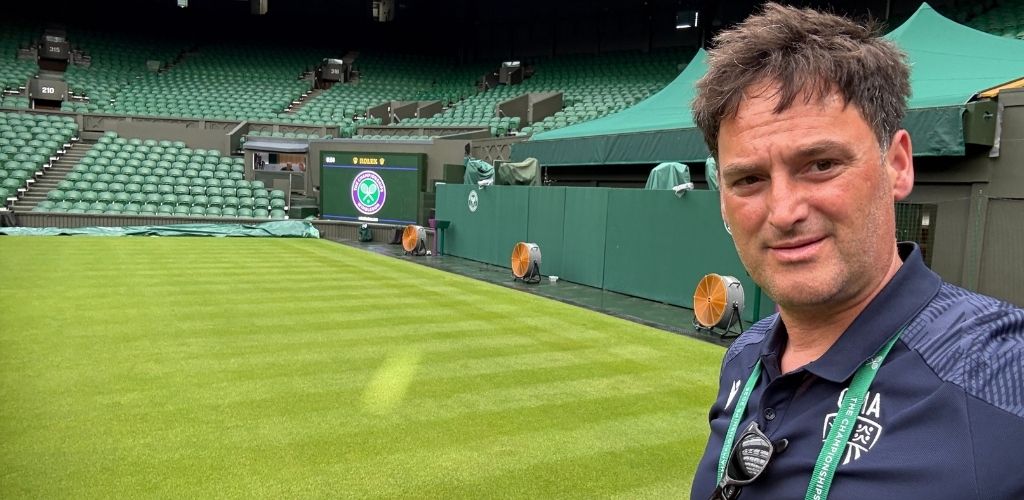
In the lead-up to The Championships, the Grounds Management Association's Learning Programme Lead, Bojan Jovanovic, was given a unique opportunity to spend three days embedded within the Wimbledon Grounds Team from 27–29 June 2026.
Working alongside some of the most experienced professionals in sports turf management, including Neil Stubley, Head of Courts & Horticulture at the All England Lawn Tennis Club (AELTC), Bojan gained first-hand insight into the preparation required to deliver the world's most prestigious grass-court tennis tournament.
In this three-part report, Bojan reflects on the attention to detail that makes Wimbledon the benchmark for natural grass court management, sharing key lessons and observations from an unforgettable professional development experience.
By Bojan Jovanovic
Day 1
My first day shadowing the Wimbledon Grounds Team focused on pre-Championship operations alongside Neil Stubley, Jonathan Entwistle and Will Brierley. The day provided an excellent introduction to the planning, preparation and teamwork required before The Championships begin.
The principal areas covered included court preparation, performance testing, site orientation, operational procedures, weather monitoring, and the final evening decision-making process before the tournament.
Throughout the day I shadowed:
Neil Stubley - Head of Courts & Horticulture at the AELTC (31 years at Wimbledon, 31st Championships)
Jonathan Entwistle - Head Grounds person at the AELTC (4th Championships)
Mark Ferguson- Head agronomist at the AELTC
Will Brierley - Senior Groundsman person at the AELTC
Their willingness to explain every stage of the operation offered an invaluable insight into how Wimbledon consistently delivers world-class playing surfaces.
The day officially began at 5:30am, with my arrival shortly before 7:00 am. Following accreditation, which took approximately 10–15 minutes, I was introduced to the site layout, including the official staff entrance, welfare areas and grounds maintenance compound.
My accreditation allowed access to Championship and practice courts.
Court Preparation and STRI Performance Testing
All Championship courts had already been mown and line marked before I arrived. Following Neil’s recommendation, I spent part of the morning with the STRI performance testing team, observing the technical assessments undertaken before play.
Measurements included:
- Surface hardness using the Clegg Hammer
- Surface moisture
- Chlorophyll (turf greenness)
- Grass density and surface quality
The STRI team explained both the equipment and testing methodology, providing an excellent overview of how Wimbledon objectively monitors court performance.
One interesting discussion focused on surface hardness.
The target values were approximately 180–200 gravities, with only minor differences recorded between Centre Court and other Championship courts. Following periods of rainfall earlier in the week and subsequent dry weather, the courts had reached excellent playing condition ahead of the tournament.
Operational Training and Court Preparation
Throughout the Day I saw several operational rehearsals. These included:
- Court cover deployment drills
- Net inspections
- Court set-up procedures
- Assistant team coordination
One particularly interesting exercise involved a timed rain cover deployment. Following the call from the Chair Umpire, the assistant team practised entering the court, removing equipment and deploying the covers within strict target times.
Although the timings were not disclosed, the exercise clearly demonstrated the level of preparation expected before The Championships begin.
Practice Court Management
Will also explained how player practice sessions are coordinated. He is responsible for ensuring players rotate efficiently across Championship practice courts while working closely with the Referees’ Office to maintain the daily practice schedule. This ensures every player receives equal preparation time while protecting the quality of the playing surfaces.
Staffing and Tournament Support
I also learned more about how Wimbledon expands its workforce during The Championships. Assistant grounds teams work in rotating groups throughout the event, with overnight cover provided whenever poor weather is forecast.
Additional support staff are brought in from Raynes Park and the Roehampton Club, helping maintain the exceptionally high presentation standards across all Championship courts.
Public Practice Day
One particularly interesting development this year was Wimbledon hosting its first public practice day.
Spectators were able to purchase tickets to watch players practise before the tournament officially began, following a model already used successfully at the US Open, Australian Open and Roland Garros.
Approximately 1,000 tickets were made available. It will be interesting to see whether this becomes a permanent feature in future Championships.
Attention to Detail
One of the strongest impressions throughout the day was the team’s attention to detail. A minor irrigation pipe leak was identified (outside courts) and resolved quickly through effective communication between the grounds and irrigation teams.
Similarly, small presentation issues were dealt with immediately, demonstrating the exceptionally high standards expected across the site.
Weather Monitoring and Evening Preparation
Weather conditions were monitored continuously throughout the day using several independent forecasting systems, with updates reviewed approximately every fifteen minutes.
As the day concluded, the Centre Court roof was closed following media activities.
Once play and practice had finished, all Championship courts were irrigated before being covered overnight.
Between approximately 7:00 pm and 9:15 pm, the grounds and court assistant teams worked together to water, inspect and protect every court ahead of the final preparations before The Championships.
On Centre Court, I assisted with positioning the circulation fans beneath the closed roof to improve airflow, regulate moisture levels and help maintain optimum playing conditions for the opening day.
Day 2
The second day of my Wimbledon shadowing took place on the final preparation day before The Championships. Sunday focused on final operational briefings, court allocations, performance testing and completing every aspect of court preparation before the tournament officially began.
The day provided valuable insight into how Wimbledon transitions from tournament preparation to tournament operations.
Morning Team Briefing
The day began at approximately 7:40 am with the full grounds team meeting.
Will welcomed the team and explained the operational plans for the next two weeks. Every member of the grounds team was allocated to their Championship court, with approximately six staff assigned to each court throughout the tournament.
Each team reviewed their responsibilities and became familiar with their allocated court before the Championships began.
Court Inspections
Following the briefing, I accompanied Neil, Mark and John to Centre Court and No.1 Court.
Morning activities included:
- Visual inspections
- Removal of annual meadow grass (Poa annua)
- Inspection for overnight fungal activity
- Removal of overnight court covers
- Final presentation checks
These inspections ensured every Championship court met Wimbledon standards before the final preparation day.
Final Court Preparation
As Sunday is the final non-match day, Championship courts remained closed to players. Practice activity was concentrated on the AP Practice Area, allowing the Championship courts to receive their final preparations.
Throughout the day the grounds teams completed:
- Final presentation work
- Equipment checks
- Bench preparation
- Court furniture inspections
- Final nutritional and maintenance tasks
Will also supervised further training exercises with the court assistant teams, practising efficient rain cover deployment.
Weather and Evening Operations
During the afternoon the management team completed another inspection of every Championship court. Centre Court and No.1 Court remained uncovered because the roofs were closed.
Neil, Mark, John and I positioned the court circulation fans beneath the roof to improve airflow and reduce humidity around the playing surface. All remaining Championship courts were covered by the assistant teams.
After approximately 7:00 pm, the AP Practice Area was cut and line marked, preparing it for player practice on the opening morning.
Rather than carrying out a full irrigation programme, targeted hand watering was completed around areas exposed to the greatest sunlight. I assisted the team with this work.
Day 3
My third and final day coincided with the opening day of The Championships.
This provided an exceptional opportunity to observe how months of preparation are transformed into live tournament operations, with the grounds, horticultural and performance testing teams working together to maintain Wimbledon’s world-renowned standards.
Horticultural Operations
Before joining the grounds team, I spent time with the Head Gardener discussing Wimbledon’s horticultural operation. The permanent horticultural department consists of approximately 12–15 full-time staff, supported by an additional 10–15 seasonal staff during The Championships.
Responsibilities include:
- Irrigation
- Hanging baskets
- Floral displays
- Landscape maintenance
- Sustainable plant management
- Reusing plants across the estate after the tournament
This demonstrated the significant contribution horticulture makes to the Wimbledon experience beyond the courts themselves.
Championship Court Preparation
Morning maintenance included:
- Removing overnight rain covers
- Mowing
- Line marking
- Final presentation inspections
- Equipment preparation
The same carefully planned routine was completed across every Championship court before players arrived. The Practice Area had already been prepared the previous evening and was available from early morning.
Drone Technology and STRI Testing
I again spent time with the STRI team observing their daily testing programme. A new experience was the use of drone technology.
The drone captured aerial photographs from approximately 45/55 metres to help monitor turf colour, surface wear, court presentation and surface uniformity. The team also explained current drone regulations and how aerial imagery is becoming an increasingly valuable monitoring tool during major tournaments.
Tournament Operations
By approximately 10:00 am, all maintenance work had been completed. The grounds team then gathered for the traditional Wimbledon breakfast before taking up their allocated positions.
Once play commenced, the grounds teams supported Chair Umpires and court officials by preparing courts between matches, replacing towels, supporting court changeovers and remaining on standby for weather-related operations.
One interesting operational detail was that Court 11 had been designated as the Championship practice court for Centre Court and No.1 Court players during the opening stages of the tournament.
Agronomic Monitoring
Later in the morning I discussed Wimbledon’s nutrient monitoring programme with Mark. Grass clippings are routinely collected from several Championship courts and analysed to monitor nitrogen, phosphorus, potassium, macro nutrients and micronutrients.
Long-term monitoring helps guide future nutritional programmes and confirms the effectiveness of Wimbledon’s agronomic management. Recent testing has shown nutrient levels to be performing extremely well, with only minor observations regarding zinc levels that present no concern for turf performance.
Evening Court Operations
As matches finished throughout the evening, grounds teams immediately began their evening maintenance programmes. Centre Court No.1 completed play shortly before 8:30 pm, allowing final inspections, irrigation and roof closure.
Centre Court was the final court to finish, with play concluding at approximately 10:15 pm. Following the final match, the grounds team immediately prepared the court for the following day through irrigation, inspections and overnight protection.
Before leaving Wimbledon, I thanked Neil, John, Mark, Will and the wider grounds team for their generosity and willingness to share their knowledge throughout the three days.
The final day demonstrated the remarkable professionalism behind Wimbledon.
What impressed me most was not only the exceptional quality of the courts, but the calm, confident and highly experienced approach shown by every member of staff. Every individual understood their role, worked collaboratively and delivered world-class standards without unnecessary pressure or drama.
The three-day shadowing opportunity has been one of the most valuable professional development experiences of my career. It has significantly expanded my understanding of elite natural turf management, tournament operations, performance quality standards and team leadership.
I am sincerely grateful to Neil Stubley, Mark Ferguson, John Entwistle, Will Brierley and the entire Wimbledon Grounds Team for welcoming me and sharing their knowledge so openly. It was a privilege to experience first-hand the preparation behind one of the world’s most prestigious sporting events, and I hope to have the opportunity to return in the future.